The books / Scientists & Inventors
Galileo Galilei
The Man Who Looked Up
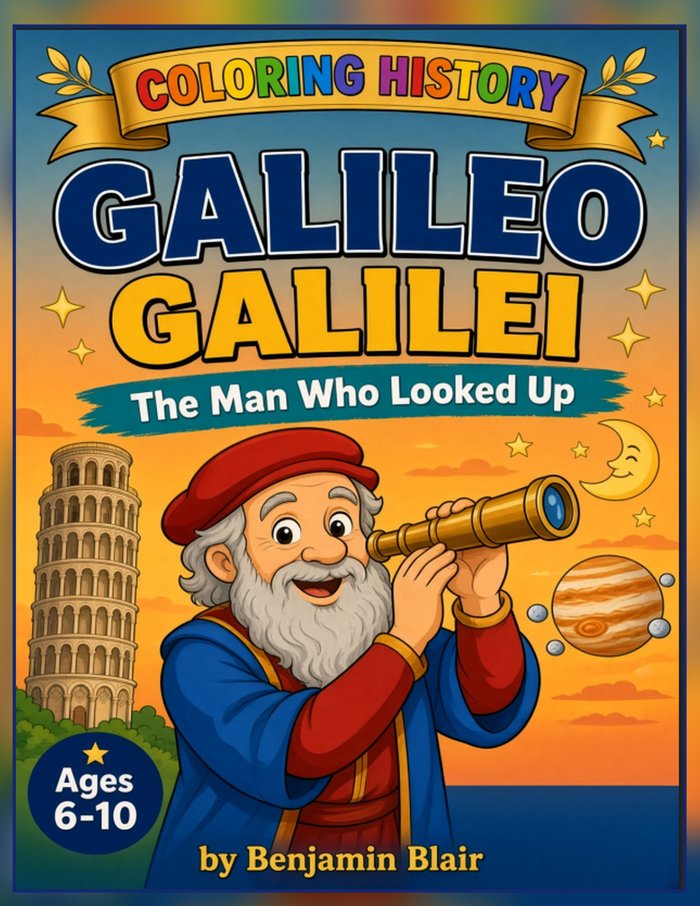
Galileo Galilei built his own telescope and pointed it at the night sky. He found mountains on the Moon and four moons going around Jupiter! Kids color 18 scenes from his life, each paired with a short, easy page about what really happened.
- Ages 6 to 10
- 40 pages, 8.5 × 11 in
- 18 scenes to color
- Paperback, printed on one side
He built a telescope, pointed it at Jupiter, and found four new moons.
Who was Galileo?
Galileo Galilei was born in Pisa, Italy, in 1564. Most people just call him Galileo. He was a teacher, a builder of instruments, and one of the first people to study the sky through a telescope. He found things nobody had ever seen, wrote them down so other people could check, and changed the way we understand where the Earth sits in space. Some people call him the father of modern science.
The lamp that swung
There is a famous story about Galileo as a student in the cathedral in Pisa. A lamp hanging from the ceiling was swinging back and forth. Galileo timed the swings using his own pulse and noticed something odd: whether the swing was big or small, each one took the same amount of time. He later used that idea to design better clocks. Whether or not the story happened exactly that way, it shows how Galileo worked. He did not just wonder. He measured.
He tried things
Galileo became a professor of mathematics, first in Pisa and then in Padua. He liked to test ideas instead of just believing what old books said. For example, people believed that heavy things fall faster than light things. Galileo rolled balls down ramps, timed them, and showed that this was not true. His way of asking a question, running a test, and writing down the result is the way scientists still work today.
A night on the roof
In 1609, Galileo heard about a new invention from Holland, a tube with glass lenses that made far-away things look close. He built his own, and then a better one, and then an even better one. In the winter of 1609 and 1610 he pointed it at the sky. The Moon was not smooth, as everyone thought. It had mountains and craters. The Milky Way was made of countless stars. And next to Jupiter were four little lights that moved from night to night. They were moons going around Jupiter. He published it all in a small book so others could look for themselves.
Earth goes around the Sun
Galileo's telescope helped him believe something that was dangerous to say out loud: the Earth goes around the Sun, not the other way around. A scientist named Copernicus had suggested it years before, but most people, including powerful leaders of the church, believed the Earth sat still at the center of everything. In 1633, Galileo was put on trial and made to say he was wrong. He spent the rest of his life under house arrest at his home near Florence, but he kept working and writing. His daughter, a nun named Maria Celeste, wrote him loving letters that we can still read today.
What we kept
Galileo died in 1642. The four moons he found are still called the Galilean moons. The spacecraft that visited Jupiter in the 1990s was named Galileo in his honor. In 1992, the church said that it had been wrong to punish him. Every scientist who tests an idea instead of just trusting an old book is following Galileo. So is every kid who looks up at the night sky and asks what is out there.
What's in the book
The 18 coloring scenes follow his life in order: A Boy in Pisa, The Lamp That Swung, He Tried Things, Time Can Be Measured, Far Away Looks Close, A Night on the Roof, The Moon Is Not Smooth, Four Little Lights, The Sun Has Spots, Earth Goes Around the Sun, He Wrote It Down, He Loved to Teach, Letters from His Daughter, He Kept Thinking, He Still Looked Up, What We Kept.
- A pronunciation page
- A map of Galileo's Italy
- A "What We Kept" page on the ideas we still use
- An "I Colored History" certificate
Free Galileo Galilei coloring page
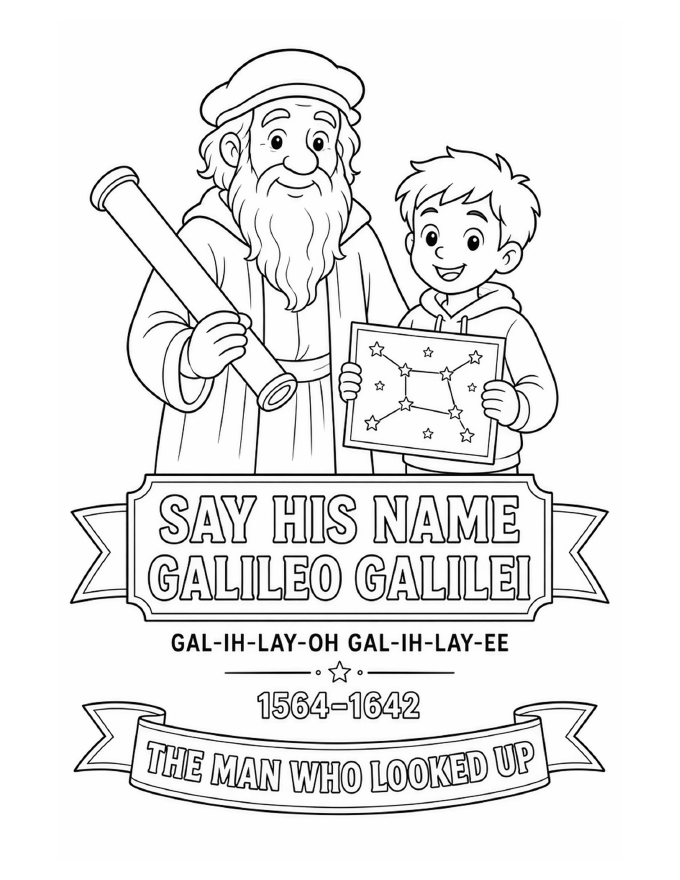
This is the first coloring page from the book, with his name, how to say it, and the years he lived. Print it on regular letter paper. It is free for home and classroom use.
Download the PDFWant the other 17 scenes? Order the book for $9.99.