The books / Scientists & Inventors
George Washington Carver
The Man Who Fed the Soil
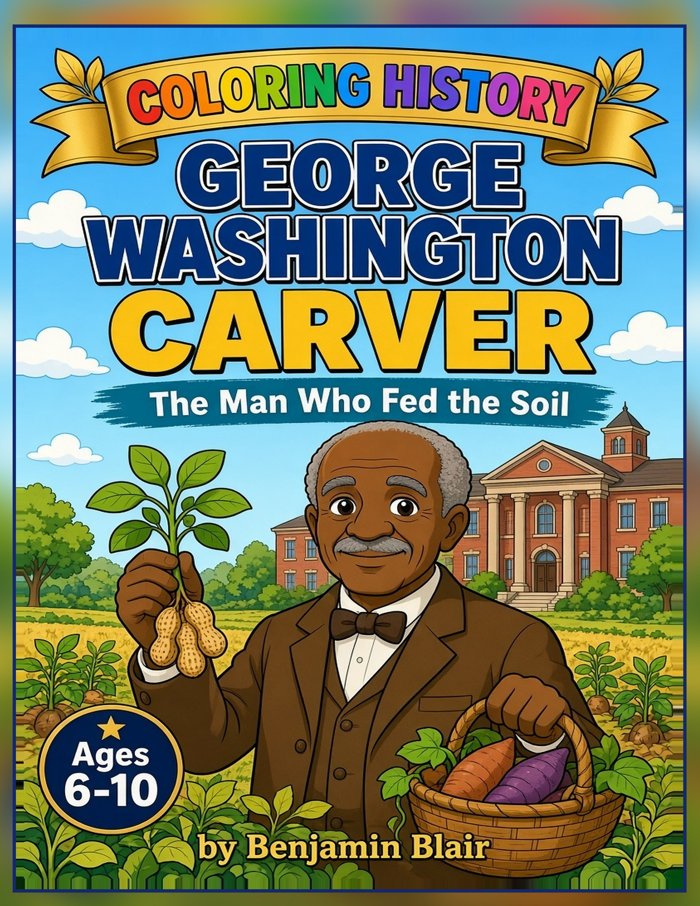
George Washington Carver grew up on a Missouri farm, where neighbors called him the plant doctor. He taught farmers how to make tired soil healthy again! Kids color 18 scenes from his life, each paired with a short, easy page about what really happened.
- Ages 6 to 10
- 40 pages, 8.5 × 11 in
- 18 scenes to color
- Paperback, printed on one side
Neighbors called him the plant doctor before he was ten.
Who was George Washington Carver?
George Washington Carver was a plant scientist and a teacher. He was born in Missouri around 1864. Nobody wrote down his birthday, so we do not know the exact year. He spent most of his life at Tuskegee Institute in Alabama, where he taught farmers how to bring worn-out soil back to life by planting peanuts and sweet potatoes, and he found hundreds of new ways to use those crops.
A hard beginning
George was born into slavery on a farm owned by Moses and Susan Carver. Slavery was a terrible wrong, and it ended when George was still a baby. He lost his mother when he was very small, and the Carvers raised him and his brother. George was often sick and could not do heavy farm work, so he spent his days in the garden and the woods. He had a gift for nursing weak plants back to health. Neighbors started bringing him their sick plants, and they called him the plant doctor.
Learning to read
Susan Carver taught George to read, and he loved books. But the school near the farm would not let Black children in. So when he was about eleven, George left home to find a school that would. He walked to the next town, worked for his room and board, and kept going from school to school for years. He was the first Black student at Iowa State, where he studied plants like a scientist, and when he graduated they asked him to stay and teach. He was their first Black teacher too.
Tuskegee
In 1896, a famous leader named Booker T. Washington asked George to come teach at Tuskegee Institute, a school for Black students in Alabama. George said yes and stayed for 47 years. He saw a big problem right away. Farmers in the South grew cotton every single year, and cotton takes food out of the soil. The ground was tired. Crops grew poorly, and families went hungry.
Peanuts and sweet potatoes
George's answer was crop rotation. Plant cotton one year, then peanuts or sweet potatoes the next. Peanut plants have tiny helpers on their roots that put food back into the soil. Farmers tried it, and the land got healthy again. But now they had mountains of peanuts and nobody to buy them. So George went into his lab and found hundreds of uses for peanuts and sweet potatoes: flour, oil, soap, dye, and more. He also built a wagon full of tools and plants, the Jesup Wagon, and drove it from farm to farm so farmers who could not come to school could learn anyway.
What we kept
George was an artist too. He painted flowers with paints he made himself from Alabama clay, and one of his paintings was shown at the 1893 World's Fair in Chicago. He died in 1943 and gave his life savings to help others study science. That same year, the farm where he was born became a national monument, the first one in the United States to honor an African American. Farmers still rotate crops today, and every kid who plants a seed and takes care of the soil is thinking like George.
What's in the book
The 18 coloring scenes follow his life in order: A Hard Beginning, A Boy Who Loved Plants, Learning to Read, Iowa School, Tuskegee Classroom, Cotton Tired the Soil, Crop Rotation, The Peanut Plant, Sweet Potatoes, The Plant Lab, The Wagon School, Paint from Plants, His Students, A Garden Walk, Soil Can Rest and Grow, What We Kept.
- A pronunciation page
- A map of George's journey from Missouri to Iowa to Alabama
- A "Soil Can Rest and Grow" page for your own garden
- A "What We Kept" page and certificate
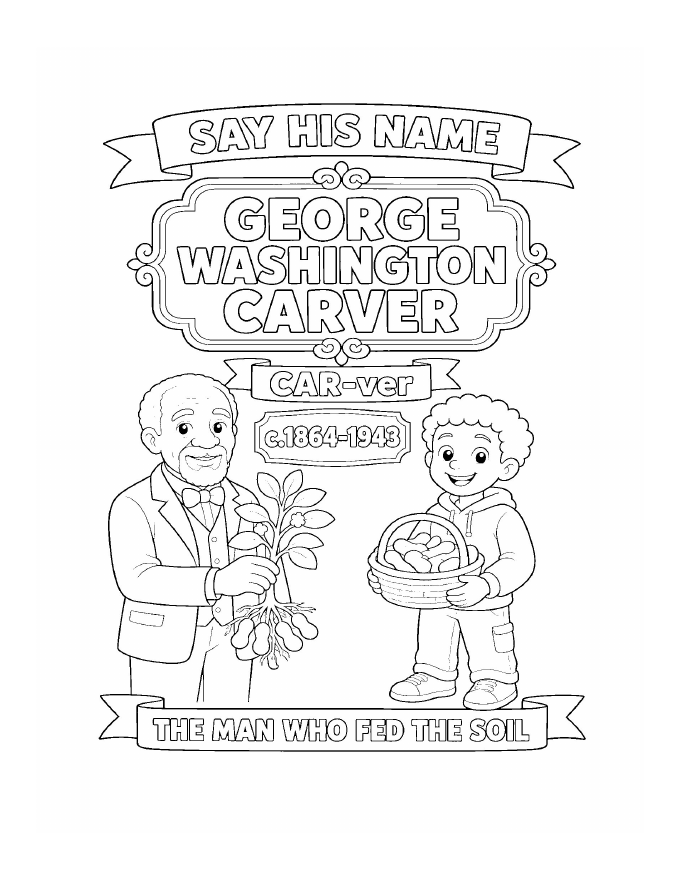
Free George Washington Carver coloring page
This is the first coloring page from the book, with his name, how to say it, and the years he lived. Print it on regular letter paper. It is free for home and classroom use.
Download the PDFWant the other 17 scenes? Order the book for $9.99.